 FGX Realty
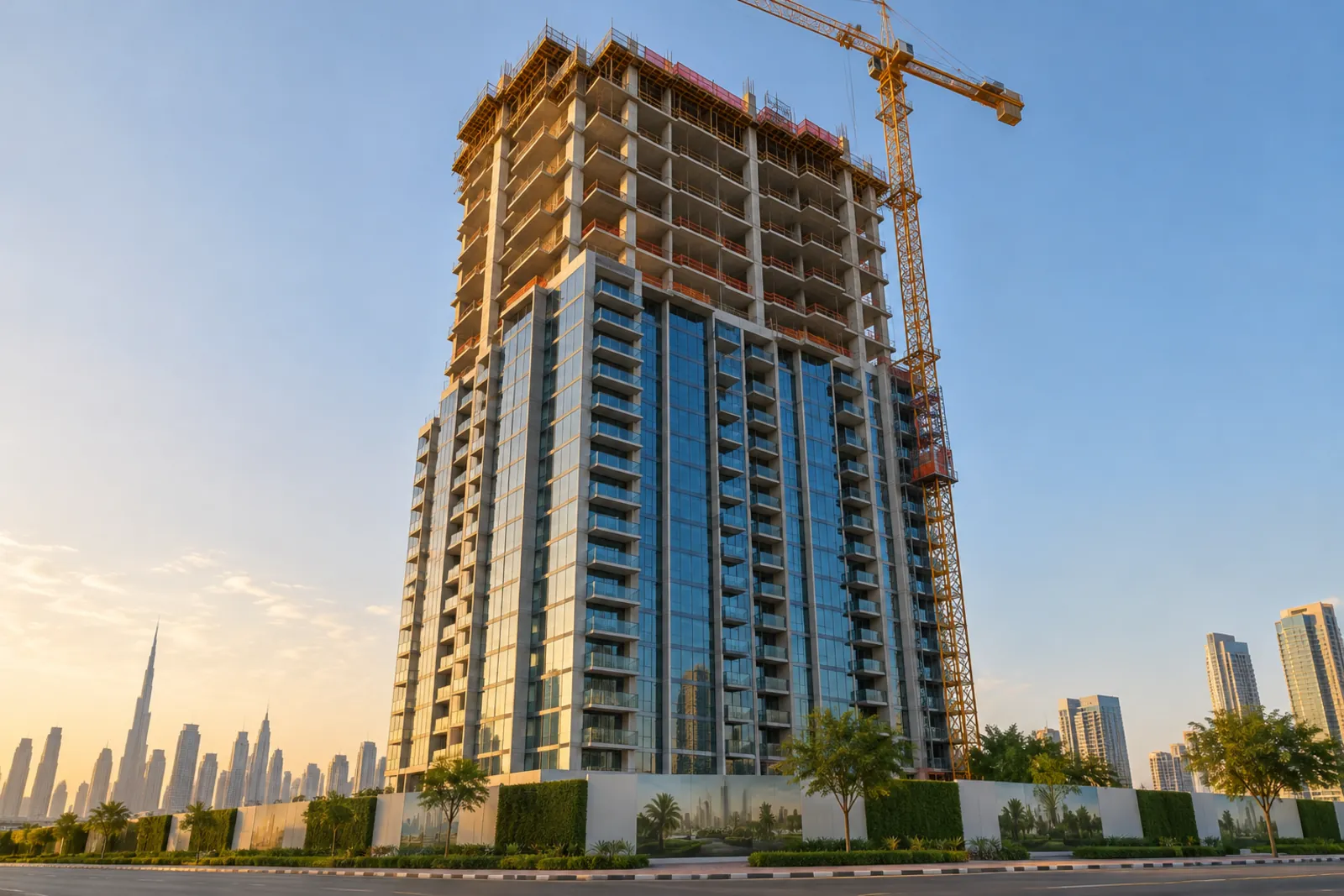
Buying a home that does not exist yet means trusting a developer with a large share of the price for several years. Dubai's answer, built up since 2007 and tightened since, is a legal framework around that trust: project escrow accounts, mandatory registration of every off-plan sale, and statutory rules for what happens when a project stalls or a buyer defaults. This guide explains each layer, what it does and does not protect, and how to check a developer and project yourself before you pay.
Three layers of protection
- Escrow. Your payments go into an account that belongs to the project, not to the developer, and can only be spent on building it.
- Registration. Developers must be licensed and registered, projects must be approved, and every off-plan sale must be entered on DLD's interim register, known as Oqood.
- Rules for failure. The law sets out what happens if a project is cancelled, and limits what a developer can keep if a buyer stops paying.
Layer one: escrow accounts under Law No. 8 of 2007
Law No. 8 of 2007 Concerning Escrow Accounts for Real Estate Development is the foundation. Its key provisions:
- Licensed developers only. No developer may operate unless entered in DLD's Register of Real Estate Developers and licensed by the competent authorities.
- No marketing without permission. A developer may not advertise off-plan units in the media or at exhibitions without DLD's written authorisation.
- A separate account per project. To sell off-plan, the developer must open an escrow account in the project's name with an escrow agent accredited by DLD. Each project needs its own account.
- Money reserved for construction. The account is dedicated exclusively to building that project, and the developer's creditors cannot attach the money in it.
- Developer loans go in too. If a developer borrows against the project, the lender must deposit the loan into the escrow account.
- A retention after completion. The escrow agent keeps 5% of the account's value after the completion certificate is issued, releasing it to the developer one year after units are registered in buyers' names.
- A plan for emergencies. If a project is not completed, the escrow agent, after consulting DLD, must take steps to preserve depositors' rights, either by getting the project finished or by refunding payments.
- Criminal penalties. Developing without a licence, offering units in fraudulent projects, or misappropriating project money is punishable by jail and a fine of at least AED 100,000, or either.
To open the account, the developer has to submit, among other things, the land title deed, approved designs, an auditor-certified estimate of the project's costs and revenues, and a standard sale contract. In other words, a project needs real land, real approvals and a funded plan before it can take your money legally.
Layer two: registration and Oqood under Law No. 13 of 2008
Law No. 13 of 2008 regulates the Interim Real Property Register, the official record of off-plan sales.
- Land and approvals first. A developer may not start a project or sell units off-plan before taking possession of the land and obtaining the required approvals.
- Unregistered sales are void. Every sale or other disposition of an off-plan unit must be entered on the interim register. A sale that is not registered is void.
- No sales in unapproved projects. Contracts to sell off-plan units in projects not approved by the competent authorities are null and void.
- Limited resale fees. Developers may not charge fees on resales except administrative costs approved by DLD.
- Area protection. If the delivered unit is larger than contracted, the developer cannot charge more. If it is smaller, the developer must compensate you unless the difference is inconsequential.
- Final registration on completion. Once the building receives its completion certificate, the developer must register units in the names of buyers who have met their obligations, and DLD can do so at a buyer's request.
In practice this means your Oqood certificate is the proof that your purchase exists in the eyes of the law. An Oqood-registered unit can also be sold or mortgaged before completion.
Layer three: when things go wrong
If a project is cancelled or never starts
Under Article 11 of Law No. 13 of 2008, as replaced by Law No. 19 of 2020, where a developer has not started work for reasons beyond its control, or a project is cancelled by a final reasoned decision of RERA, the developer must refund all payments made by buyers, following the escrow procedures of Law No. 8 of 2007.
Disputes over cancelled and unfinished projects go to a dedicated body. In December 2020, Decree No. 33 of 2020 reconstituted it as the Special Tribunal for Liquidation of Cancelled Real Property Projects, with powers to settle rights in unfinished and cancelled projects, appoint auditors and direct escrow trustees. Khaleej Times reported that its rulings are final.
If a project is delayed
A delay short of cancellation is mainly a contractual matter. Your rights come from the SPA: the anticipated completion date, the grace period and any compensation clause. Escrow means your payments are reserved for construction, but it does not guarantee a handover date. That is why a developer's track record on previous handovers deserves as much attention as the brochure.
If the buyer stops paying
The same law protects buyers from arbitrary cancellation. The developer must notify DLD, which gives the buyer 30 days' written notice and may mediate. Only then, depending on completion, can the developer act:
| Project completion | Developer's options |
|---|---|
| Over 80% | Keep the contract and claim the balance, request a DLD auction, or terminate and keep up to 40% |
| 60% to 80% | Terminate and keep up to 40% of the unit value |
| Under 60%, work started | Terminate and keep up to 25% of the unit value |
Amounts above those limits must be refunded within one year of termination or within 60 days of resale, whichever is earlier, and the buyer can still go to court or arbitration. Our guide to off-plan payment plans shows how to plan instalments so you never get close to this.
Escrow protects where your money goes. It does not protect when you get your keys. Check both the legal registration and the developer's delivery record.
How to check a developer and project before you pay
- Check the advert. Since 24 April 2023, every property advert in Dubai must display the QR code issued with its DLD advertising permit. Scan it and confirm the details match. Our guide on verifying a listing walks through this.
- Look the project up. DLD's project status service in the Dubai REST app and on the DLD website shows registered projects with details such as the developer, completion percentage and escrow information.
- Match the escrow account. The SPA and the payment instructions should show the project's escrow account, held with an accredited bank. Pay instalments only into that account. The DLD fee goes to DLD.
- Get your Oqood certificate. After booking and paying the registration fee, you should receive confirmation that the sale is on the interim register. Chase it if it does not arrive.
- Check the people. Your broker should have a valid Broker Registration Number and their office an ORN.
- Study the developer's record. Look at completed buildings, original versus actual handover dates, and the condition of buildings already occupied. The developers page gathers the developers most active today, including Emaar Properties and Sobha Realty.
- Read the SPA before you pay more than a booking amount. Pay particular attention to the completion date, grace period, specifications and default clauses.
Red flags
- A request to pay into a personal account, or into a company account that is not the project's escrow account.
- A "pre-launch" sale with a signed contract but no project registration and no prospect of Oqood. Launch expressions of interest are common in Dubai, but they should be receipted by the developer, refundable on the stated terms and converted into a registered booking.
- An advert with no permit QR code, or a QR code that leads to a different property or company.
- Pressure to transfer money before you have seen the SPA.
- Promises of guaranteed returns or buy-back that are not written into the contract.
Frequently asked questions
Is my money safe if the developer gets into financial trouble?
Escrow money is reserved for the project and cannot be seized by the developer's creditors. If a project fails, the escrow agent and DLD must act to complete it or refund buyers, and the special tribunal handles disputes. The process can take time, which is a cost in itself.
Does an Oqood certificate mean I own the property?
It means your purchase is legally registered and can be sold or mortgaged. The title deed is issued after completion, once you have met your payment obligations.
Can I see the escrow account details?
Yes. They should appear on your SPA, and DLD's project status service shows project information including escrow details. If a developer cannot give you the escrow account for a project, do not pay.
What if construction stops for a long time?
Start with the developer and the SPA. If the project is formally cancelled, the refund rules apply. You can also raise concerns with DLD and RERA, which oversee developers and escrow accounts.
Who regulates off-plan developers in Dubai?
The Dubai Land Department, through its regulatory arm, the Real Estate Regulatory Agency (RERA), licenses and oversees developers, brokers, escrow and off-plan registration.
Official sources
- Law No. 8 of 2007 on escrow accounts%20of%202007%20Concerning%20Escrow%20Accounts%20for%20Real%20Estate%20Development%20in%20the%20Emirate%20of%20Dubai.html)
- Law No. 13 of 2008 on the interim real property register%20of%202008.html)
- Law No. 19 of 2020 amending Law No. 13 of 2008%20of%202020%20Amending%20Law%20No.%20(13)%20of%202008%20Regulating%20the%20Interim%20Real%20Property%20Register%20in%20the%20Emirate%20of%20Dubai.html)
Next step
If you are considering a launch, an FGX advisor can check the project registration, escrow details and the developer's delivery record with you before you commit. Book a call to go through a specific project.
This guide is general information, not legal, tax or financial advice. Rules and fees change; confirm current figures with the Dubai Land Department or your advisor before you commit.