 FGX Realty
Most property fraud in Dubai does not involve forged title deeds. It involves real-looking adverts for properties the advertiser has no right to sell or rent, and a request for money before anyone has checked. The good news is that Dubai has made verification unusually easy: almost everything you need can be checked in a few minutes on the Dubai Land Department (DLD) website or the Dubai REST app. Here are the checks to run before you share documents or pay anything.
The checks at a glance
| Check | Where | What it tells you |
|---|---|---|
| Advertising permit and QR code | Scan the QR code on the advert | The advert is approved by RERA for that property and company |
| Broker and office licence | DLD website or Dubai REST, using the BRN and ORN | The agent and the brokerage are licensed |
| Title deed | DLD's Title Deed Verification service | The deed is genuine and current |
| Project and Oqood (off-plan) | DLD project status service and the seller's Oqood | The project is registered and the seller's purchase exists |
| Tenancy (rented units) | The Ejari registration | The current lease is registered |
1. The advertising permit and its QR code
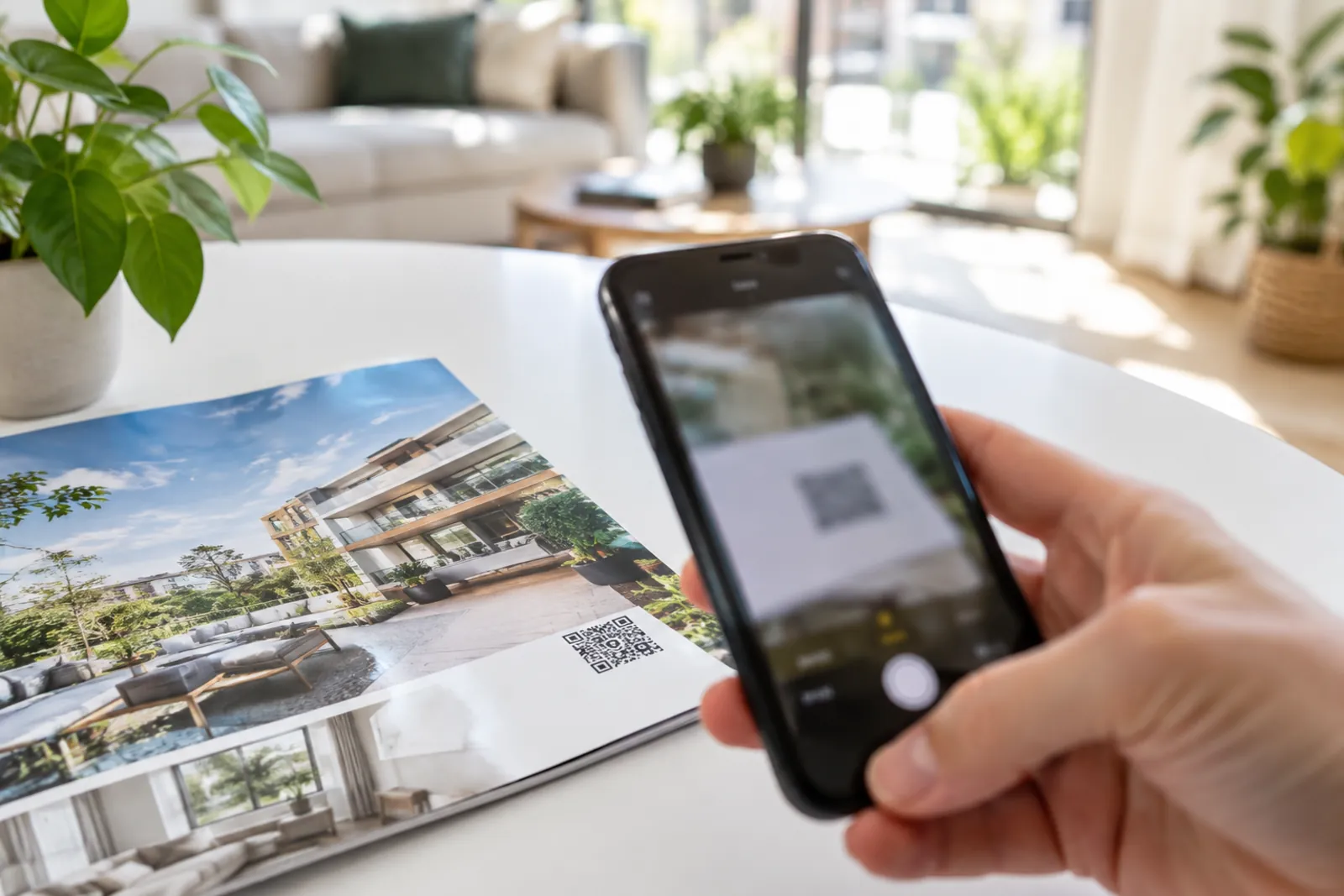
Every property advert in Dubai needs an advertising permit issued through RERA's Trakheesi system. Since 24 April 2023, DLD's "Madmoun" service has made it mandatory for every real estate company to display the QR code issued with that permit on all adverts, whether online, printed or on video.
Scanning the code opens the permit details on DLD's site, including information about the advertising company, the advert and the property. Compare them with what you are being shown:
- Is the company on the permit the same company you are dealing with?
- Do the property type, location and size match the listing?
- Does the permit still appear as valid?
DLD has continued to tighten control of listings. Gulf News reported in April 2025 that DLD's AI-enabled advertising governance platform had automatically corrected 29% of about 279,000 listings issued since the previous October, and that recent measures included limiting the number of brokers who can advertise the same property and requiring transacted properties to be taken down promptly.
If an advert has no QR code, or the code leads somewhere unrelated, treat it as unverified and ask for the permit before you go any further.
2. The broker and the brokerage
Every broker in Dubai must be registered with RERA and carry a Broker Registration Number (BRN). Every brokerage has an Office Registration Number (ORN). You can check both through DLD's services on its website or in the Dubai REST app.
- Ask for the agent's BRN and the company's ORN at the start, and check that they belong to the same company named on the advertising permit.
- Make sure the agent is acting for a brokerage, not privately.
- Expect standard RERA contracts: Form A between a seller and their broker, Form B between a buyer and their broker, and Form F, the MOU between buyer and seller.
FGX Realty's ORN is 1487934. You can check it exactly the same way, and you should.
3. The title deed
DLD's Title Deed Verification service checks whether a Certificate of Title or title deed issued by DLD is valid. DLD lists it as free and immediate, available on its website and in the Dubai REST app.
- Ask the agent for a copy of the title deed early, before you sign an MOU.
- Verify it, then check that the owner named on it is the person signing, or that whoever signs holds a valid power of attorney specific to the sale.
- If the property is mortgaged, that is normal, but the seller's bank will need to be paid off on transfer day. Your advisor should ask for the bank's liability letter before the transfer is booked.
- If the seller is a company, the signatory needs company documents showing they can sign.
A power of attorney signed outside the UAE should be notarised and legalised for use in the UAE. Have your advisor review it before you pay a deposit to anyone acting under it.
4. Off-plan: the project and the seller's Oqood
For an off-plan unit bought from a developer, check that the project is registered. DLD's project status service, available in the Dubai REST app and on DLD's website, shows registered projects with details such as completion percentage and escrow information. Payments should go only to the project's escrow account.
For an off-plan unit bought from another investor, ask for the seller's Oqood certificate, which shows their purchase is registered on DLD's interim register, and a statement from the developer showing what has been paid. A seller who cannot produce Oqood registration is not in a position to sell. More on the legal protections is in how Dubai protects off-plan buyers.
5. Rented properties: Ejari and the landlord
If you are buying a tenanted unit, or renting one, the tenancy should be registered in Ejari, Dubai's tenancy registration system.
- Buyers of tenanted units should ask for the tenancy contract and Ejari certificate, so you know the rent, expiry date and notice position. Rent increases on renewal are capped by reference to RERA's rental index, so the existing rent matters.
- Tenants should check that the person signing the lease is the owner on the title deed, or a broker or property manager authorised by the owner.
6. The price against registered transactions
A genuine listing can still be a bad deal, and an unusually low price is the most common hook in fraudulent ones. Before you make an offer, compare the asking price with recent registered sales of similar units in the same building or community. DLD publishes transaction data on its website, and a good agent will show you the comparable sales behind their advice rather than other asking prices.
Look at price per square foot rather than headline price, and adjust for floor, view, layout and condition. If a unit is priced far below every comparable sale, there is usually a reason: a tenant on a long lease at a low rent, a problem with the building, arrears on the service charges, or a listing that is not what it seems.
Checking a power of attorney
Many Dubai sellers live abroad and sign through an attorney, which is legitimate. Ask for a copy of the power of attorney early and check three things: that it names the specific property or clearly covers its sale, that it was notarised and, if signed abroad, legalised for use in the UAE, and that it has not been revoked. Your advisor or a lawyer should review it before any deposit is paid to, or through, the attorney.
Red flags
- A price well below similar listings, combined with urgency to pay a "holding deposit".
- An agent who will not give a BRN, an ORN or the advertising permit.
- Requests for payment to a personal account, in cryptocurrency or through a payment app.
- An owner who is always abroad, with no viewing possible and no power of attorney.
- Contact only via messaging apps, with no company email, office or licence.
- Documents in which names, unit numbers or areas do not match each other.
- An off-plan "resale" where the seller cannot show Oqood or a developer statement.
In a genuine Dubai resale, the price is paid by manager's cheque at the trustee office on transfer day. Nobody legitimate needs you to wire the price to an individual beforehand.
How money should move in a legitimate deal
- Resale. A security deposit, commonly 10%, given under a signed MOU and held by the brokerage. The balance, the seller's mortgage payoff and the DLD fee are paid by manager's cheques or DLD's payment channels at the trustee office, where ownership changes in the same appointment.
- Off-plan from a developer. Instalments paid into the project's escrow account, plus the DLD registration fee.
- Commission. Paid to the brokerage under the RERA form you signed, not to an individual agent's personal account.
The full step-by-step process is in our guide to buying property in Dubai as a foreigner.
Frequently asked questions
What if an advert shows a permit number but no QR code?
The QR code has been mandatory on all adverts since April 2023. Ask the agent for it, or check the permit through DLD's services yourself. A listing that cannot produce one should not get your deposit.
Is a listing on a large property portal automatically verified?
Major portals require permits, but checks can lag and adverts can be copied. Scan the QR code yourself; it takes seconds.
What is the difference between a BRN and an ORN?
The BRN belongs to the individual broker. The ORN belongs to the brokerage. Both should be valid, and they should belong to the same company.
Can I check who owns a property before I view it?
Ask the agent for a copy of the title deed and verify it through DLD's Title Deed Verification service. A reputable agent will provide it once there is genuine interest.
What should I do if I suspect a fraudulent listing?
Do not pay. Report it to the platform and to DLD, and if money has already been sent, contact your bank and the police immediately.
Official sources
Next step
If you would like a second pair of eyes on a listing, an FGX advisor can go through these checks with you. Browse current listings, read how FGX works, or contact us with the property you are looking at.
This guide is general information, not legal, tax or financial advice. Rules and fees change; confirm current figures with the Dubai Land Department or your advisor before you commit.